
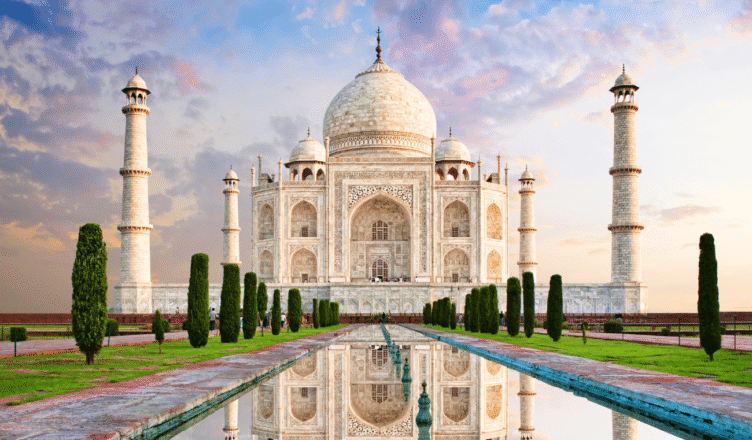
Taj Mahal: A Symbol of Eternal Love
India is a land of remarkable monuments, each echoing stories from its rich past. But among them, one stands in a class of its own — the Taj Mahal, a white marble masterpiece that has captured hearts across centuries. Located in Agra, this iconic structure is not just a marvel of architecture, but a symbol of eternal love and devotion.
🏰 A Love Story in Stone
The Taj Mahal was commissioned in 1632 by the Mughal Emperor Shah Jahan, in memory of his beloved wife Mumtaz Mahal, who died during childbirth. Overwhelmed by grief, Shah Jahan vowed to build a mausoleum so beautiful that it would be remembered forever — and he succeeded.
The construction took about 22 years and involved over 20,000 artisans and craftsmen from across the empire and beyond, including Persia and Central Asia. The result? A structure that is as much a romantic legend as it is an architectural wonder.
🏛️ Architectural Brilliance
The Taj Mahal is an exemplary piece of Mughal architecture, blending elements from Islamic, Persian, Ottoman Turkish, and Indian styles.
Its most iconic feature is the main dome, rising gracefully to a height of 73 meters (240 feet), flanked by four elegant minarets. The white marble changes color depending on the time of day — pinkish in the morning, milky white in the evening, and golden under moonlight.
The intricate inlay work on the walls, using semi-precious stones like jade, crystal, lapis lazuli, amethyst, and turquoise, forms beautiful floral patterns. Arabic inscriptions from the Quran are also etched delicately into the stone.
Surrounding the mausoleum are lush Mughal gardens, divided into quadrants symbolizing paradise. A long reflecting pool perfectly mirrors the Taj, enhancing its ethereal beauty.
🌍 A Global Icon
Designated as a UNESCO World Heritage Site in 1983, the Taj Mahal is considered one of the New Seven Wonders of the World. It draws millions of tourists every year, making it one of the most visited — and photographed — monuments globally.
But beyond the crowds and cameras, the Taj remains a place of serenity, inspiring poets, painters, photographers, and lovers for generations.
🧭 Planning Your Visit
If you’re planning to see the Taj Mahal in person:
-
Best time to visit: October to March (cooler weather and clearer skies)
-
Best time of day: Sunrise or sunset for the best lighting and fewer crowds
-
Entry tip: Closed on Fridays for general visitors; only open for prayers at the mosque
💬 Final Thoughts
The Taj Mahal is not just a tomb; it’s a testament to human emotion, carved in stone and marble. It reminds us of the power of love, the beauty of craftsmanship, and the grandeur of history. Whether you see it as a romantic tribute, an architectural triumph, or a cultural treasure, one thing is certain — the Taj Mahal leaves an impression that lasts a lifetime.