
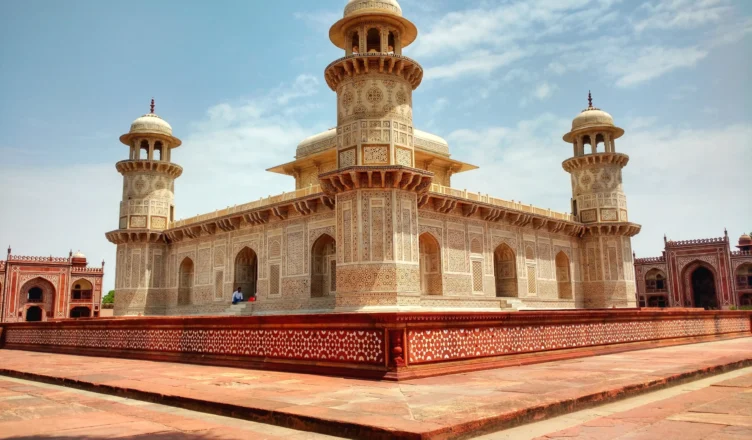
Itmad-Ud-Daulah’s Tomb: Agra’s Hidden Gem and the “Baby Taj”
When it comes to Agra, the majestic Taj Mahal often takes center stage. But nestled quietly along the banks of the Yamuna River lies a lesser-known jewel — the Tomb of Itmad-Ud-Daulah. Delicately designed and steeped in history, this monument is often called the “Baby Taj” for its architectural resemblance to its more famous counterpart. Yet, in many ways, it stands apart as a groundbreaking piece of Mughal architecture.
🏛️ A Monument of Love — and Legacy
Itmad-ud-Daulah’s Tomb was commissioned by Nur Jahan, the powerful and influential wife of Emperor Jahangir, in memory of her father, Mirza Ghiyas Beg, who held the title Itmad-ud-Daulah (Pillar of the State).
Constructed between 1622 and 1628, the tomb was the first Mughal monument built entirely in white marble, marking a significant departure from the red sandstone used in earlier structures like Agra Fort and Humayun’s Tomb.
✨ Architectural Innovation
This elegant mausoleum is a precursor to the Taj Mahal, both in material and design, and introduced several elements that later became central to Mughal architecture.
🌟 Key Features:
-
Material: Pure white marble inlaid with semi-precious stones like jasper, lapis lazuli, onyx, topaz, and cornelian.
-
Pietra Dura: The tomb is adorned with intricate inlay work forming delicate floral patterns — a technique later perfected in the Taj Mahal.
-
Structure: The tomb stands on a red sandstone platform with hexagonal minarets on all four corners — another first in Mughal architecture.
-
Layout: Set within a charbagh (four-part Persian garden), symbolizing paradise.
-
Ceilings & Walls: Inside, you’ll find some of the finest frescoes and carvings, with latticed marble screens (jalis) that create beautiful light effects.
This tomb’s geometric precision, refined decoration, and symmetry were revolutionary at the time — and helped shape the future of Mughal design.
👨👩👧 Family Legacy
The tomb houses not just Mirza Ghiyas Beg, but also his wife, Asmat Begum, and several other family members. Nur Jahan’s strong presence in its creation reflects her own influence in court — she was one of the most politically astute and artistically inclined women in Mughal history.
📍 Visiting Itmad-ud-Daulah’s Tomb
-
Location: On the eastern bank of the Yamuna River, Agra, Uttar Pradesh
-
Timings: 6:00 AM to 6:00 PM (Closed on Fridays)
-
Entry Fee:
-
₹30 for Indian citizens
-
₹310 for foreign nationals
-
-
Best Time to Visit: November to March (pleasant weather for exploring gardens and marblework)
📝 Travel Tip: Visit during the early morning or late afternoon for the best lighting to appreciate the inlay work — and to enjoy a peaceful experience away from the crowds.
📷 Why It’s Worth Visiting
Though smaller and less frequented than the Taj Mahal, Itmad-ud-Daulah’s Tomb offers:
-
Architectural calmness: With fewer tourists, it’s ideal for slow, mindful exploration.
-
Photography paradise: The intricate marble screens and colorful inlay provide stunning photo opportunities.
-
Historical depth: It tells the story of the powerful women of the Mughal Empire, especially Nur Jahan.
💬 Final Thoughts
Itmad-ud-Daulah’s Tomb is more than just the “Baby Taj” — it’s a trailblazer. It set the stage for what Mughal architecture would become: elegant, symmetrical, and eternally beautiful. For history buffs, architecture lovers, or anyone looking to see Agra beyond the Taj Mahal, this tomb offers a unique and enriching experience.
Next time you visit Agra, take a quiet detour to this marble marvel. You might just discover that lesser-known doesn’t mean less impressive.