
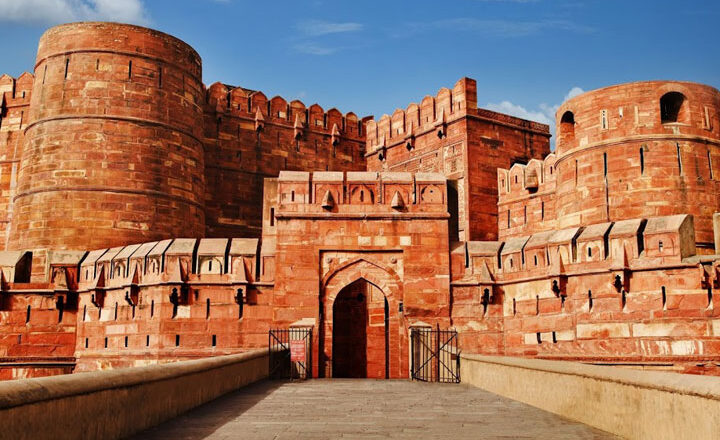
Agra Fort: The Majestic Stronghold of Mughal Grandeur
Just a short distance from the Taj Mahal lies another architectural gem that holds within its walls the echoes of India’s imperial past — the Agra Fort. Often overshadowed by its more famous neighbor, this UNESCO World Heritage Site is a masterpiece in its own right, brimming with history, power, and royal intrigue.
🏯 A Fort of Empires
The Agra Fort’s origins date back to the 11th century, when it was a brick fort held by the Rajputs. However, its transformation into a formidable Mughal fortress began in 1558, when Emperor Akbar seized it and made Agra the capital of his empire.
What followed was a massive reconstruction in red sandstone, turning the fort into a grand citadel fit for one of the world’s most powerful dynasties. Akbar, Jahangir, Shah Jahan, and even Aurangzeb left their architectural imprints within these fortified walls.
🧱 Architecture and Layout
Spread over 94 acres, the Agra Fort is semi-circular and surrounded by a 2.5 km-long double rampart with massive bastions and four gates. The most famous entrance, the Amar Singh Gate, is still used by visitors today.
Inside, the fort is like a city within a city, complete with palaces, mosques, halls, courtyards, and towers. Key architectural highlights include:
🌟 Notable Structures Inside Agra Fort
-
Diwan-i-Am (Hall of Public Audience)
This is where the emperor addressed the common people and listened to their petitions. The hall is adorned with intricate floral designs and arches. -
Diwan-i-Khas (Hall of Private Audience)
A more intimate space where the emperor met with nobles and foreign dignitaries. It once housed the legendary Peacock Throne. -
Jahangir’s Palace
Built by Akbar for his son Jahangir, it showcases a fusion of Hindu and Central Asian architectural styles. -
Khas Mahal
A stunning white marble palace with delicate ornamentation, this was Shah Jahan’s private residence. -
Musamman Burj
A beautiful octagonal tower overlooking the Yamuna River. It’s believed that Shah Jahan was imprisoned here by his son Aurangzeb — spending his final years gazing at the Taj Mahal, the tomb of his beloved Mumtaz Mahal. -
Sheesh Mahal (Mirror Palace)
This “palace of mirrors” was used by royal women and features intricate mirror mosaics and pietra dura work. -
Moti Masjid (Pearl Mosque)
A serene white marble mosque built by Shah Jahan, known for its purity and simplicity.
🛡️ A Fort of Strategic Importance
Agra Fort was not only a royal residence but also a military stronghold. Its strategic location along the Yamuna River and its robust defenses made it a key site in the power struggles between empires.
Even during the First War of Indian Independence in 1857, the fort played a pivotal role, eventually falling under British control until India’s independence in 1947.
🌍 UNESCO Recognition
In 1983, the Agra Fort was declared a UNESCO World Heritage Site for its historical and architectural significance. It represents the height of Mughal art and military architecture, showcasing a blend of Islamic and Hindu elements.
🧭 Visiting Agra Fort
-
Location: Agra, Uttar Pradesh (2.5 km from the Taj Mahal)
-
Timings: 6:00 AM – 6:00 PM, open daily
-
Best Time to Visit: October to March (pleasant weather)
-
Entry Fee:
-
₹50 for Indian citizens
-
₹650 for foreign tourists (as per latest info)
-
💬 Final Thoughts
While the Taj Mahal is a monument to love, the Agra Fort is a monument to power — a testament to the strength and splendor of the Mughal Empire. Walking through its corridors is like stepping back in time, where emperors ruled, plots unfolded, and history was made.
If you’re planning a trip to Agra, don’t make the mistake of skipping the Agra Fort. It’s not just a detour — it’s a destination in itself.